

The deal you never knew existed may have been decided weeks before your sales team had a chance to speak.
A buyer had a problem. They opened an AI tool and asked which companies could help solve it. The answer named a few vendors. Your competitors made the list. Your company did not.
No lost-deal notification arrived. No prospect told your team it had been considered and rejected. There was no sales call to review and no objection to overcome. Your company simply never entered the conversation.
That is a different kind of pipeline problem. You cannot follow up with a buyer who never knew to contact you.
For B2B companies, positioning has always affected whether prospects understand the value of an offer. Now it can affect whether a company is considered at all. As buyers use AI tools to research categories, compare vendors, and build initial shortlists, a company that is difficult to describe can be difficult to recommend.
The problem is not that every buyer has replaced Google with AI. The problem is that the buying journey is changing, and unclear positioning makes it harder for your company to show up wherever buyers begin.

Your Next Buyer May Start With a Question, Not a Search
A buyer researching a category does not always begin with a list of vendors. They may start with a broad question: Which firms help mid-market manufacturers improve demand generation? What should a B2B services company look for in a growth advisory partner? Which providers specialize in a particular operational challenge?
That question is not a request for your brand name. It is a request for a useful answer.
AI tools can turn that broad question into a short list of options, along with explanations of why those options might fit. Buyers can then use that list as a starting point for further research, checking recommendations with colleagues, peers, analysts, and other sources.
G2's 2026 AI Search research reported that 51% of software buyers surveyed began research in an AI chatbot more often than Google, up from 29% a year earlier. The report also found that 69% said a chatbot had pointed them toward a different vendor than the one they initially planned to consider. These figures concern software buyers, not every B2B buyer, but they illustrate how AI-assisted research can influence vendor consideration.
The important point is not the exact percentage. It is the change in where discovery can happen.
If your company is absent from the initial shortlist, you may never get the opportunity to explain your strengths, answer questions, or demonstrate why you are different. Your sales team sees fewer conversations and may assume demand is slowing. The cause could be happening earlier, before a lead ever reaches your CRM.
A Strong Company Can Still Be Difficult to Recommend
A company can have excellent people, years of experience, and a strong track record while still being difficult for the market to describe.
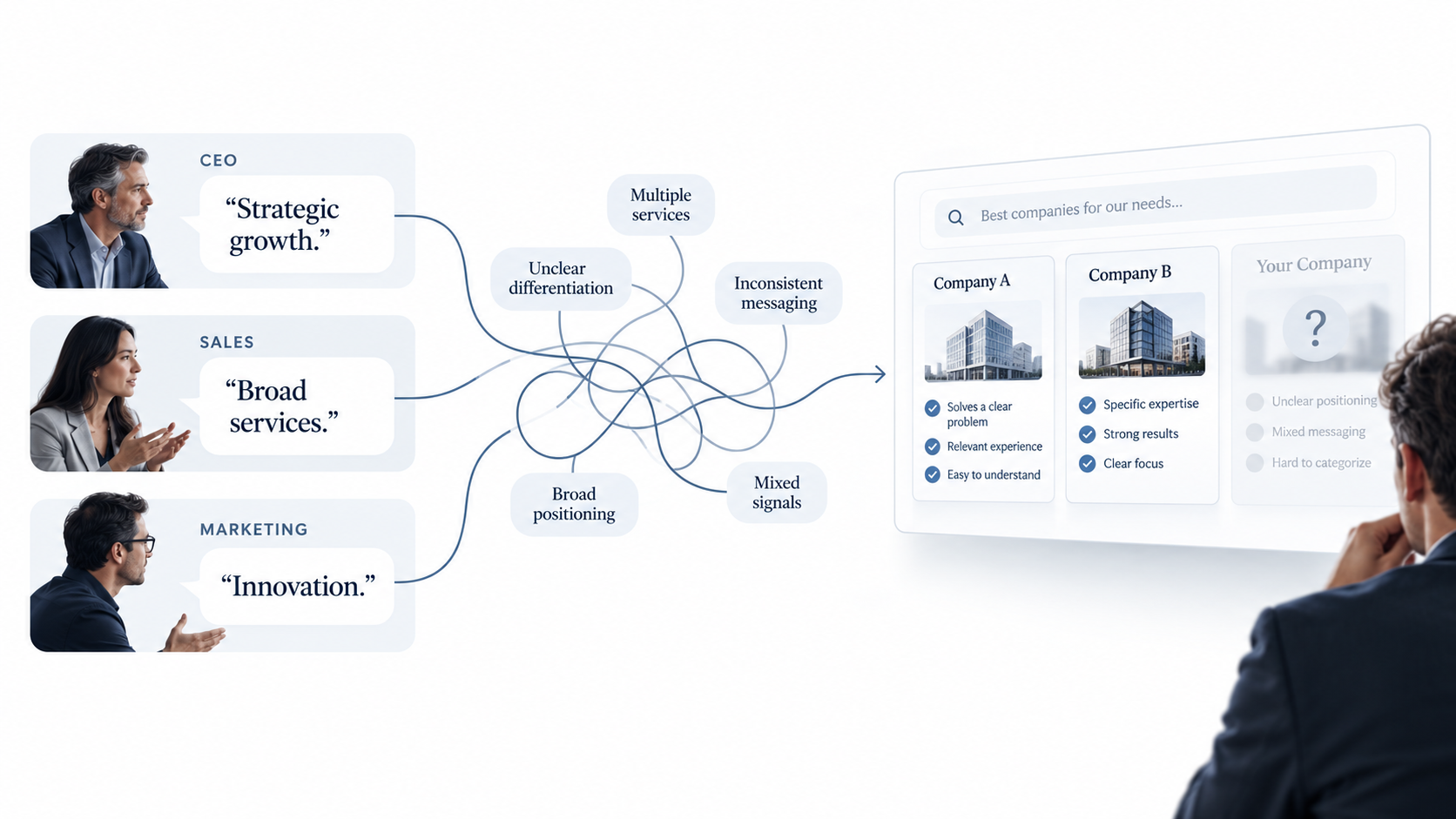
Ask three people inside the business what the company is best at. The CEO might talk about strategic growth. Sales might describe a broad range of services. Marketing might lead with innovation or transformation. Each answer may contain some truth, but together they create an unclear picture.
Now consider the buyer trying to compare providers. They need to understand which problems your company solves, which customers it serves best, and why it belongs on the shortlist. If the public information about your company sends mixed signals, a buyer or an AI system has less consistent evidence to work with.
This does not mean an AI tool understands your business the way a customer or employee does. It works from available information and patterns in that information. If your positioning is inconsistent across your website, service pages, case studies, interviews, and other public sources, the resulting description may be incomplete or inaccurate.
Your company may be capable of solving a specific, valuable problem. But if that capability is buried beneath broad claims and an expansive list of services, it becomes harder to recognize.
Being good at what you do is not the same as being easy to identify as the right choice.
AI Cannot Repeat a Position the Market Cannot Understand
AI-generated recommendations are not a substitute for a strong market position. They make the quality of that position more consequential.
If your team cannot agree on who you serve, what problem you solve, and why customers choose you, adding another AI tool will not resolve the underlying issue. Nor will publishing more content that repeats the same vague claims.
Clarity starts with decisions.
Who is the ideal customer? Which business problem is important enough that the customer will pay to solve it? What makes your approach relevant to that customer? What evidence supports the claim?
Those answers should be consistent without making every page or sales conversation sound identical. Your website should explain the core value clearly. Service pages should make the problems you solve concrete. Case studies should show what changed for customers, ideally with named outcomes and specific evidence. Sales materials should reinforce the same position rather than introducing a different story.
This is the connection between positioning and discoverability. Buyers need to recognize that you are relevant. The public evidence about your company needs to support that conclusion.
If your positioning breaks quietly inside the business, the cost used to appear later in the sales process: confused prospects, longer conversations, and weaker conversion. Now the cost can appear earlier, when a buyer is building a shortlist and never sees a reason to consider you.
The Fix Is Not Another AI Tool
The first response to a new discovery channel is often to look for a new tool or a set of technical tricks. But the starting point should be the same one that supports any effective growth strategy: know the customer, define the position, and provide evidence.
Start by clarifying your ideal customer profile. Be specific about the kinds of organizations you serve best, the problems they need to solve, and the circumstances in which your company is a strong fit. A broad audience description makes it harder to communicate a distinctive reason to choose you.
Next, sharpen your positioning. Replace general claims such as “we deliver innovative solutions” with a clear explanation of the problem you solve, the audience you serve, and the value your approach provides. A buyer should not need to interpret your website to understand where you fit.
Then make your proof easy to find. Publish case studies, customer outcomes, expert explanations, and service information that support your claims. Avoid making the buyer piece together the story from disconnected pages or generic descriptions.
Finally, review how your company is described across its public presence. The goal is not to force every channel to use identical wording. It is to make sure the same underlying position is recognizable wherever a buyer encounters you.
These are not simply SEO tasks. They are core business decisions about how your company is understood. Search visibility may benefit, but the deeper objective is to make your company easier for the right buyer to recognize, evaluate, and recommend.
Your Positioning Problem May Be Costing You Before the First Call
When inbound conversations decline, it is natural to look at lead volume, campaign performance, or sales follow-up. Those areas deserve attention. But they do not explain every lost opportunity.
Some buyers may be forming preferences before they contact a vendor. AI tools can influence that early research, but they do not eliminate the need for clear positioning, credible proof, or a well-defined audience. They make those fundamentals more important.
The companies that are easiest to recommend are not necessarily the largest or the loudest. They are the ones whose strengths are clear, whose fit is understandable, and whose claims are supported by evidence.
That is the work to do before investing in another tool or producing another batch of content. Make it clear who you help, what you help them achieve, and why your company is qualified to do it.
If the market cannot explain what makes you the right choice, you should not expect a new channel to solve that problem for you.
The shortlist is being formed whether your sales team is present or not. Make sure your company has a clear reason to belong on it.
If your pipeline is thinning and you can't explain why, do something about it now. Book a call and tell us what’s going on.