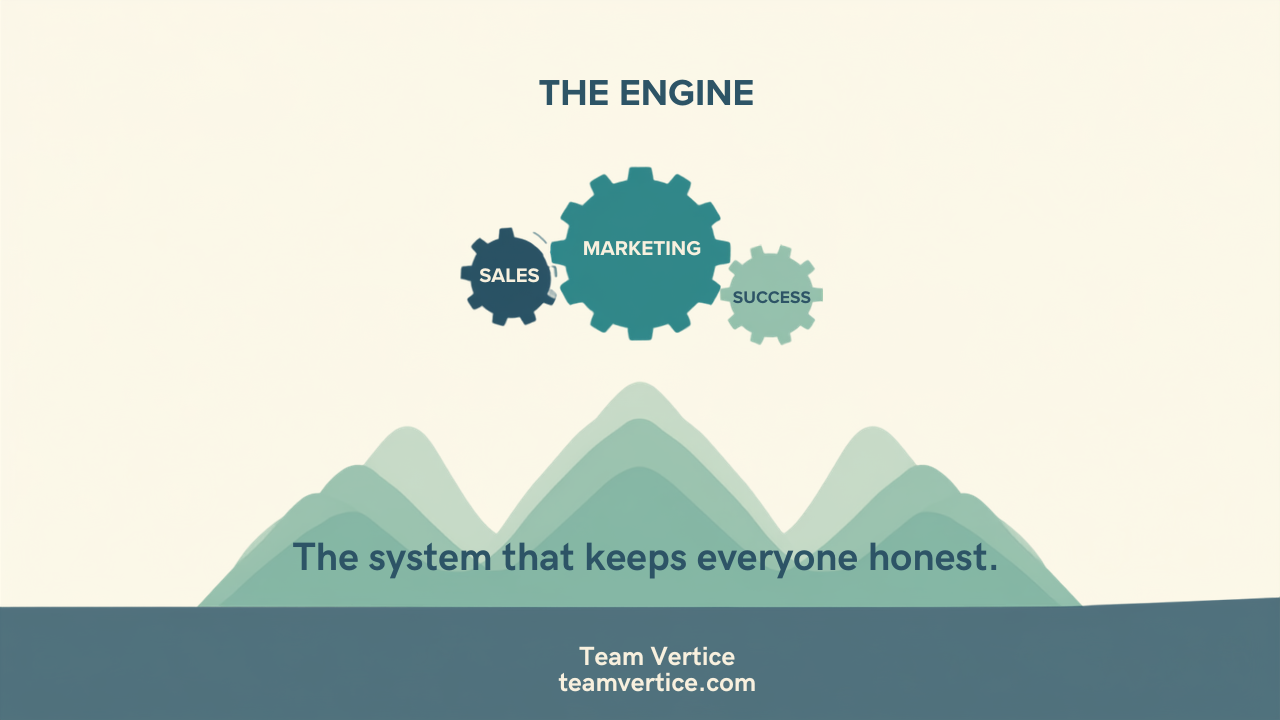
What RevOps Is (And Why Most CEOs Get It Wrong)
Ask five people in the same company what RevOps means and you will get five different answers and one blank stare. Most CEOs think it is a job title they should maybe hire for eventually. It is not a job title. It is the operating system underneath sales, marketing, and customer success, and if that system does not exist, all three functions are quietly working against each other while everyone calls it growth.
That is the real problem with RevOps. Companies treat it like a nice-to-have hire instead of a structural requirement. By the time leadership realizes the revenue engine has no connective tissue, the damage is already showing up in the forecast, the pipeline, and the tension between departments who all think they are doing their job correctly.
RevOps Is Not A Job Title, It's An Operating System
Strip away the acronym and RevOps is simple. It is the function that makes sure sales, marketing, and customer success are running on the same data, the same definitions, and the same set of facts. It is what prevents each team from optimizing for itself at the expense of the whole company.
A CEO who has never had RevOps usually assumes the CRM and a shared spreadsheet are close enough. They are not. A CRM full of unreliable data is not a system. It is a records room. RevOps is the decision to build a revenue engine that behaves like a system: documented, repeatable, and accountable to numbers everyone trusts.
What Breaks Without It
Sales and marketing argue about lead quality because nobody owns the definition of a qualified lead. Forecasts miss because the pipeline data feeding them is not reliable. The tech stack fills up with tools nobody actually uses and data nobody actually trusts. Leadership ends up making strategic calls off anecdote and gut feel because the real numbers are not clean enough to act on.
None of this looks like a RevOps problem from the inside. It looks like a sales problem, or a marketing problem, or a forecasting problem. It is the same root cause wearing three different costumes.
Where To Start
Fix the CRM first. If the data going in is wrong, everything built on top of it is wrong, no matter how good the strategy looks on a slide. Next, agree on lead definitions. MQL, SQL, and SAL cannot mean something different in every department's head. Then fix attribution: find out what is actually generating pipeline instead of guessing. Finally, build the handoff protocol between marketing and sales so a lead does not disappear into a gap nobody owns.
This is not a six-month rebuild. It is a sequence, and most of it is a decision to stop tolerating bad data rather than a technical overhaul.
What Strong RevOps Unlocks
Faster decisions, because the data underneath them is trustworthy. Forecasts that hold up when the board asks hard questions. Marketing and sales that stop fighting over whose fault the miss was and start working off the same playbook. And the ability to scale without depending on heroics from whoever happens to be holding the pipeline together this quarter.
The Business Case At $20M To $100M
Every dollar of pipeline leak you stop is pure margin. The companies that exit at premium multiples almost always have clean revenue systems, because buyers can see the difference between a business that runs and a business that depends on one person remembering everything. You cannot hire your way out of a broken process. Sales efficiency improves faster than headcount ever will once the system underneath it actually works.
RevOps is not overhead. It is the thing that makes every other growth investment actually pay off.
Fix the system. Then the strategy has something solid to stand on.
If your pipeline data is unreliable and your teams are arguing about whose numbers are right, the Growth System Assessment is where we start. Start Here!