

What Is Budget Planning and Why Does It Need to Start Now?

Why Budget Season Starts Earlier Than Most Teams Think
Most finance teams start budgeting in Q4 because that's when the calendar says to. But by Q4, the real decisions which teams grow, which bets get funded, which programs get cut have usually already been made informally, in hallway conversations and half-finished Slack threads.
Starting the budget conversation now means those decisions get made deliberately, with the full leadership team in the room, instead of by whoever spoke last.
TL;DR
Budget planning done early is a strategy exercise.
Budget planning done late is a triage exercise.
Start the conversation now, sort spending into protect/invest/cut, and build in checkpoints, so the budget still works when reality doesn't match the plan.
When budget planning gets compressed into a few weeks at year-end, three things happen almost every time:
Rushed decisions. Big spending calls get made in days instead of weeks.
Defensive spending. Departments pad their asks because they don't trust they'll get another chance to ask.
No room for trade-offs. There's no time to ask "if we fund this, what do we not fund?" so everything just gets a little less money instead of the right things getting the right money.
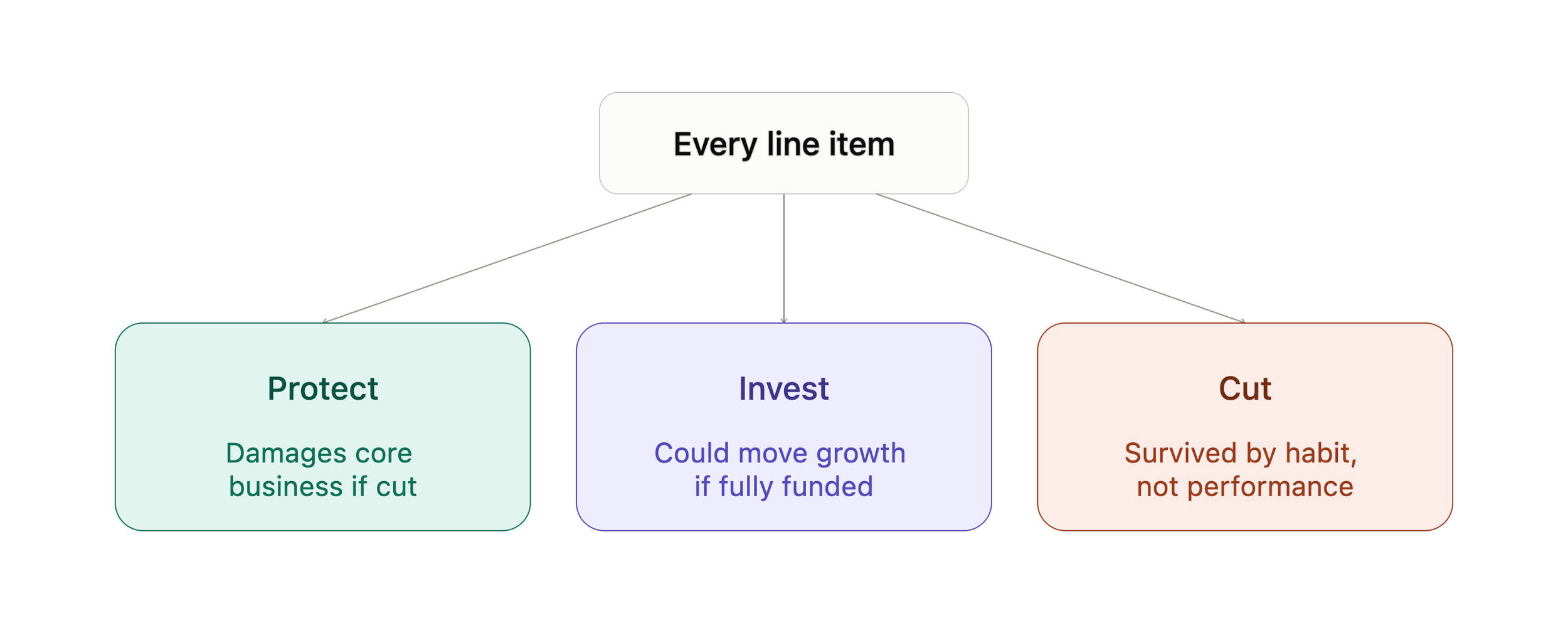
When budget conversations run late, everything gets treated the same. A better approach sorts every line item into one of three buckets:
Protect — the things that, if cut, would damage the core business (key hires, critical infrastructure, client-facing commitments)
Invest — the bets that could meaningfully move growth if funded properly, not just partially
Cut — the things that survived last year's budget by habit, not by performance
This framework forces a conversation that "just reduce everything by 10%" never does.
What Separates a Budget That Survives Contact With Reality
A good budget isn't the one that looks best in the board deck. It's the one that still makes sense in June, when revenue is ahead of plan, and in October, when it's behind.
That means building in:
Checkpoints to revisit assumptions (quarterly, not just annually)
Clear owners for each major line item
A pre-agreed process for what happens if targets move
FREQUENTLY ASKED QUESTIONS
-
At least one full quarter before your fiscal year ends, earlier if your organization has multiple departments that need to align.
-
Finance leads the process, but department heads and executive leadership should be involved early, not just asked to review a number.
-
Quarterly at minimum. Annual-only budgets are the ones most likely to fall apart by mid-year.
Ready to start planning for what’s ahead?
Click here to contact us and get started.