

TL;DR
A flat marketing budget rarely holds back growth on its own. The bigger problem is marketing budget allocation: spend spread across tools, agencies, and programs that nobody can trace to revenue. Before cutting expenses or asking for more money, map what each investment is supposed to do in the buying process, who owns it, and how you'll know it's working. Then move money toward what moves pipeline.
Key takeaways
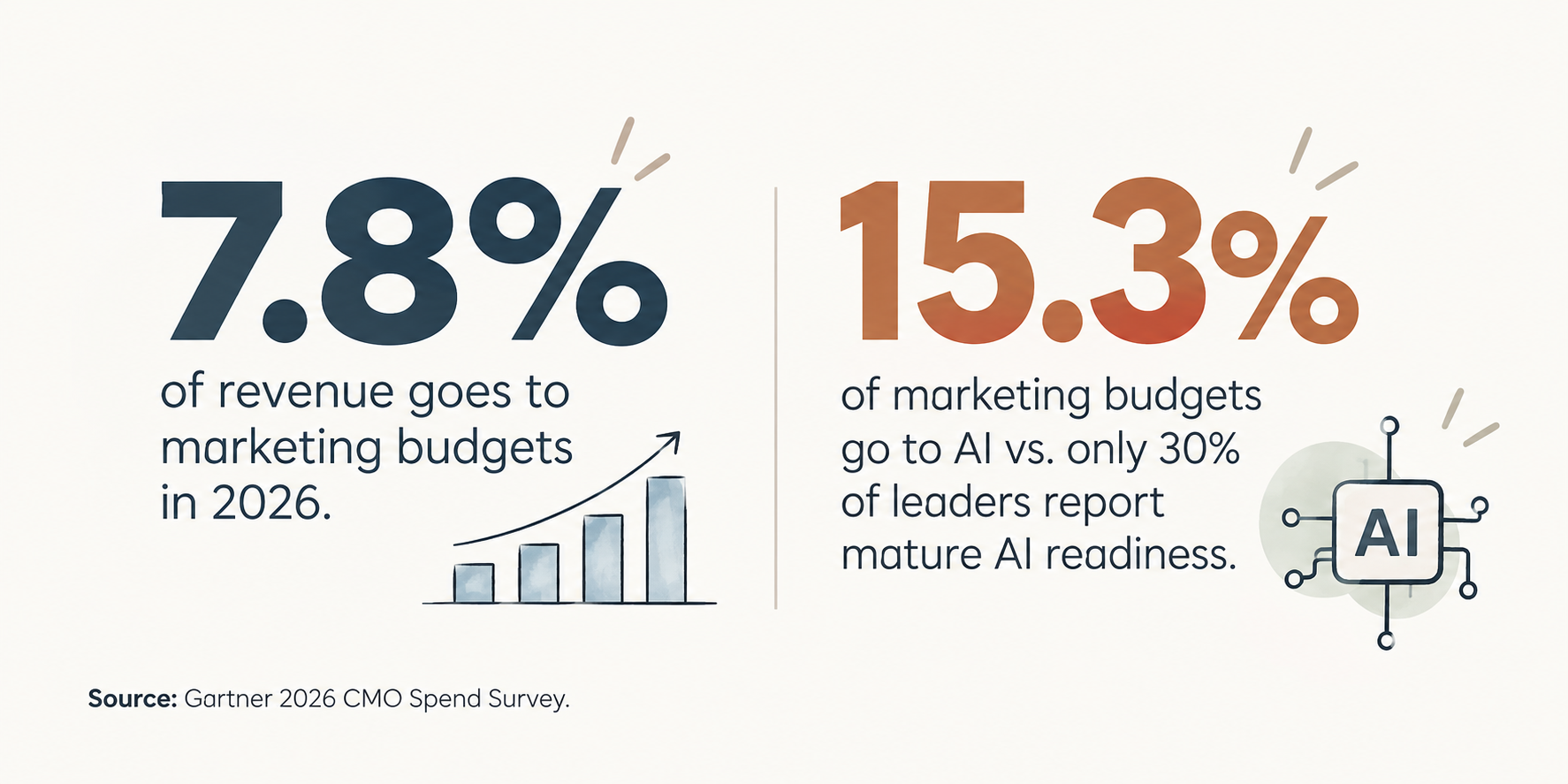
Flat budgets are the norm. Gartner's 2026 CMO Spend Survey puts marketing at 7.8% of revenue, barely up from 7.7% in 2025.
Marketing waste hides in reasonable-looking line items that don't connect to each other.
Across-the-board cuts treat every dollar as equally guilty and often kill the programs that matter most.
Every investment needs a job, an owner, an outcome, and evidence.
Ask for more budget only after you can show where the current budget goes.

Your marketing budget has been flat for years. Leadership wants more pipeline. Sales wants better leads. Finance wants a clearer return. And you're expected to deliver all three without asking for another dollar.
So you defend the line items, trim a few expenses, and hope next quarter looks better.
Waiting for a bigger budget is not a growth strategy. It's a holding pattern, and you're burning fuel the whole time.
Is a flat marketing budget what's holding back growth?
No. A flat budget is a constraint. Bad allocation is the problem.
Marketing budget allocation is how you divide spend across people, tools, partners, media, and content, and whether each piece has a defined job in producing revenue. Most mid-market B2B companies aren't underfunded. They're underconnected.
“Most mid-market B2B companies aren't underfunded. They're underconnected.”
And flat isn't going away. Gartner's 2026 CMO Spend Survey of 401 marketing leaders, most at companies above $1 billion in revenue, found budgets at 7.8% of revenue, barely up from 7.7% in 2025. If flat is the norm at billion-dollar companies, don't plan around a windfall at a $100M one.
The same survey shows where money goes anyway. Marketing teams now put 15.3% of their budgets into AI initiatives, but only 30% of those leaders say their AI readiness is mature. That's the whole pattern in two numbers: companies fund the new thing before they build the foundation it needs.
You can't fix what you can't see. Most teams can't see much.
Where does marketing waste hide?
Marketing waste rarely looks like waste. It looks like a reasonable software subscription, a long-standing agency relationship, a content program that ships on schedule. Every line item has a defensible story. The problem shows up when you look at how they work together.
Take tools. One team reports out of one platform, another maintains a separate database, and a third exports spreadsheets to build its own dashboard. You're paying three times for a view of performance nobody agrees on.
Take partners. One agency runs paid media, another writes content, a third handles brand. Each delivers exactly what's in the contract. None of them sees the pipeline. Marketing reports campaign performance. Sales reports lead quality. Finance sees the invoices.
Who connects the three?
It's like hiring three contractors to build a house and never handing any of them the blueprint. Everyone shows up. Everyone bills. Nobody owns whether the roof meets the walls.
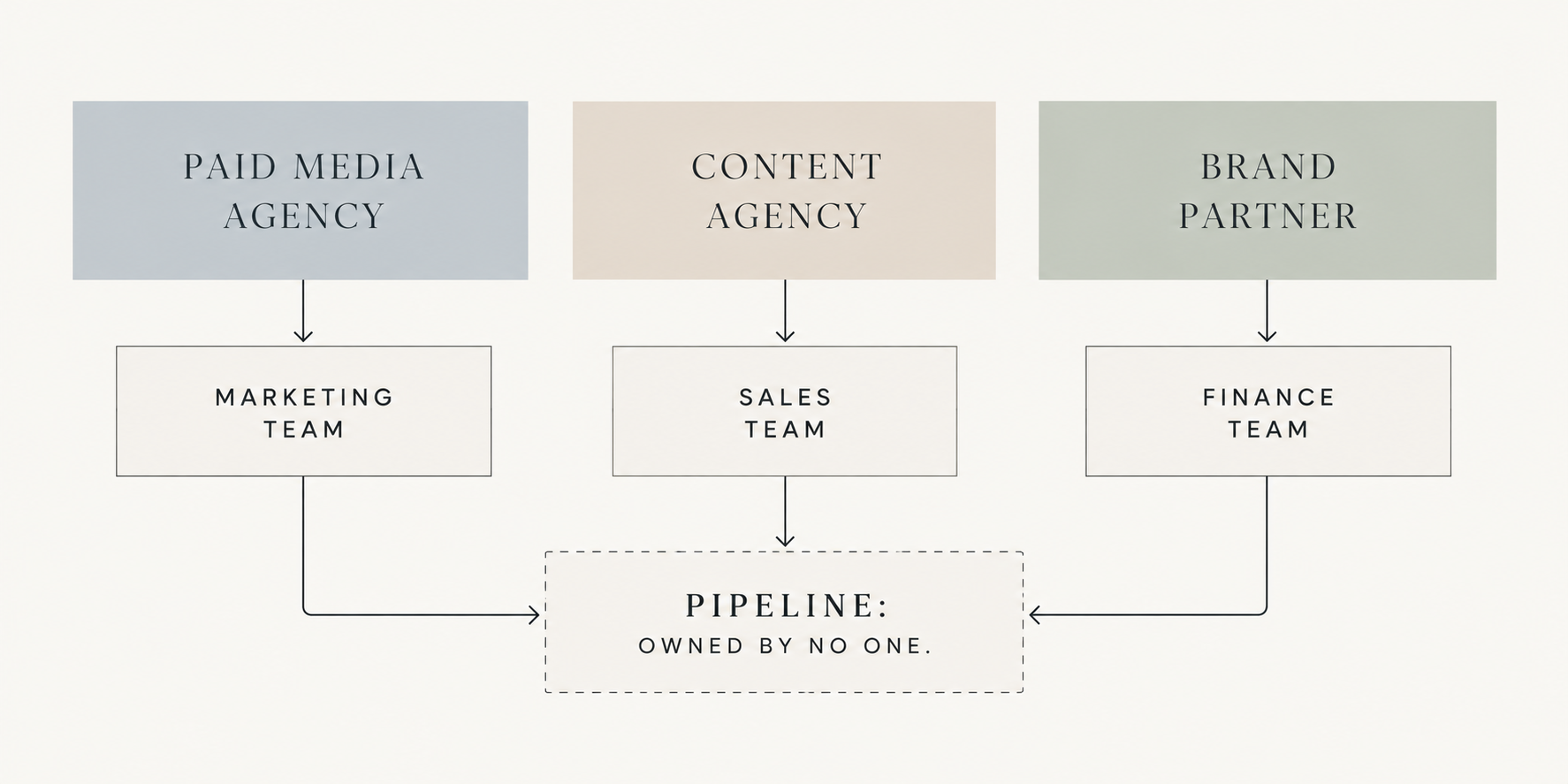
The activity is real. The invoices are real. The business impact is a guess.
How do you know your marketing spend isn't tied to revenue?
Five tells give it away.
The first is that your marketing report and your sales report tell different stories, and nobody in the room can reconcile them.
The second is that you can't name an owner for every software subscription you pay for. A tool without an owner doesn't have a purpose. It has a renewal date.
The third is that every agency hits its deliverables, and none of them can tell you what's in the pipeline this quarter.
The fourth is that your content library keeps growing while sales keeps building its own decks. If your reps won't use what marketing makes, buyers won't either.
The fifth is that the number you're proudest of is a volume number. Impressions, sessions, leads. If it never shows up in a forecast, it's an activity metric wearing a revenue costume.
“If it never shows up in a forecast, it's an activity metric wearing a revenue costume. “
Activity metrics aren't useless. They're dangerous when they become the scoreboard. A campaign can produce hundreds of leads that never become opportunities, while a quieter program shapes the handful of deals that made your year.
Seeing three or more of those tells? That's what the Growth System Assessment is built to untangle. Let's talk.
Why do most budget cuts make things worse?
The usual move is to pull up the expense list and cut whatever's easiest. Maybe a flat 10% across the board. It feels disciplined. It isn't.
Cutting from a list treats every dollar as equally guilty. You kill the slow-burn program that influences your biggest deals and keep the lead machine that floods sales with junk, because the lead machine has prettier numbers.
The other wrong fix is buying a tool to solve a reporting problem. If your current systems can't show leadership what's working, a new dashboard just gives you a better-looking version of the same confusion.
Cutting without a map is just shrinking the mess.
Want more takes like this on running marketing as a growth system? Connect with me on LinkedIn.
How should you reallocate a flat marketing budget?
Map the system before you touch the spend.
Put every major investment on the table: internal team, software, outside partners, paid media, content, events. For each one, answer four questions. What job does it do in the buying process: create demand, convert it, support sales conversations, or drive retention and expansion? Who owns it? What outcome should it move? What evidence would tell you it's working?
Anything that can't answer gets a deadline, not a renewal.
Do this with marketing, sales, and finance in the same room, working from one commercial picture. You won't get perfect attribution. B2B buying is messy, with long cycles, referrals, and influences you can't isolate. You don't need perfect. You need enough shared visibility to make a call you can defend.
Long-term bets can stay. A new market or a brand investment won't pay back in a quarter, but it still needs an owner and a way to measure progress.
Then change the questions you ask.
Instead of "Did it generate leads?" ask "Did those leads match our ideal customer and become qualified opportunities?" Instead of "Did the agency deliver on time?" ask "Did the work move the outcome we hired it for?" Instead of "Do we need more budget?" ask "What do we need marketing to accomplish?"
Move money toward what moves pipeline. Then, if you still need more, ask for it with evidence.
A smaller budget tied to revenue beats a bigger one tied to impressions.
Your budget may not grow next year. Your ability to use it still can.
“Your budget may not grow next year. Your ability to use it still can. “
FAQ
How should a B2B company approach marketing budget allocation when the budget is flat?
Start by mapping what each investment is supposed to do in the buying process, then assign an owner, a target outcome, and a way to measure it. Anything that can't answer those questions gets a deadline for proving its value. Move money from disconnected activity toward work that measurably supports pipeline.
What percentage of revenue do companies spend on marketing in 2026?
Gartner's 2026 CMO Spend Survey found marketing budgets averaged 7.8% of company revenue, up slightly from 7.7% in 2025. The survey covered 401 marketing leaders in North America, the UK, and Europe, most at companies with more than $1 billion in revenue, so mid-market benchmarks may differ.
How do I know if my marketing spend is wasted?
Common signs include marketing and sales reports that don't reconcile, software subscriptions with no clear owner, and agencies that hit deliverables but can't speak to pipeline. Another is relying on volume metrics like impressions or leads that never appear in a revenue forecast.
Should I cut marketing spend across the board to improve ROI?
Usually not. Flat cuts treat every dollar as equally effective, which often eliminates slower programs that influence large deals while keeping high-volume activity that produces weak leads. Map how spend connects to revenue first, then cut or reallocate based on evidence.
Do I need perfect attribution to tie marketing spend to revenue?
No. B2B buying involves long cycles, multiple stakeholders, and referrals that no model fully isolates. The goal is enough shared visibility across marketing, sales, and finance to make budget decisions you can defend.
If you're spending real money on marketing and can't trace it to revenue, the Growth System Assessment is where we start. Let's talk.